Home » Posts filed under ARISS
Showing posts with label ARISS. Show all posts
ARISS 20th Anniversary Event
In commemoration of the 20th Anniversary of ARISS. The Amateur Radio on the International Space Station (ARISS) program is planning a slow-scan television (SSTV) event starting on Thursday, July 20, and continuing for 2 days.
SSTV transmissions are set to get under way at 21:25 UTC, wwill feature 12 images from past and present ARISS activities. The SSTV signal should be available nearly anywhere on the globe at some point during the event. The event plans to use a computer on the ISS Russian Segment, which stores images that are then transmitted to Earth using the onboard Kenwood TM-D710 transceiver. Those receiving the images can post them at https://ariss-sstv.blogspot.com/ for viewing by the public. SSTV signals will be transmitted on 145.80 MHz using FM. The SSTV mode is expected to be PD120, with PD180 as a possible second option. Free SSTV decoder software is available on the Internet.
For more information and you can read the blog post from the ARISS site at: http://ariss-sstv.blogspot.com
ARISS Celebrates it’s 20th Anniversary through SSTV Event
In commemoration of our 20th anniversary, the ARISS team is planning to transmit a set of 12 SSTV images that capture the accomplishments of ARISS over that time. While still to be scheduled, we anticipate the SSTV
operation to occur around the weekend of July 15. We are planning for at least a 2 day operation, but are working for a potential longer operation. Note that all of this tentative and may change based on crew scheduling and
ISS operations.
Starting with our first meeting in November 1996, our joint operations on Mir, becoming the first operational payload on ISS in November 2000 to our 1103rd school contact (so far), ARISS' accomplishments have been tremendous. We have touched the lives of many and inspired and educated countless students to pursue science, technology, engineering and math careers.
Please stay tuned as more details on our SSTV event will be communicated in the coming weeks. Please spread the word. And think about how you can get students in your area involved in capturing these images. We would love to hear your stories on how that goes.
Ig
73, Frank KA3HDO
--------------------------------------------
Frank H. Bauer, KA3HDO
ISS Ham Radio Program Manager & PI
ARISS International Chair
AMSAT V.P. for Human Spaceflight Programs
Source : http://ariss-sstv.blogspot.com/2017/06/ariss-sstv-commemorative-activity.html
operation to occur around the weekend of July 15. We are planning for at least a 2 day operation, but are working for a potential longer operation. Note that all of this tentative and may change based on crew scheduling and
ISS operations.
Starting with our first meeting in November 1996, our joint operations on Mir, becoming the first operational payload on ISS in November 2000 to our 1103rd school contact (so far), ARISS' accomplishments have been tremendous. We have touched the lives of many and inspired and educated countless students to pursue science, technology, engineering and math careers.
Please stay tuned as more details on our SSTV event will be communicated in the coming weeks. Please spread the word. And think about how you can get students in your area involved in capturing these images. We would love to hear your stories on how that goes.
Ig
73, Frank KA3HDO
--------------------------------------------
Frank H. Bauer, KA3HDO
ISS Ham Radio Program Manager & PI
ARISS International Chair
AMSAT V.P. for Human Spaceflight Programs
Source : http://ariss-sstv.blogspot.com/2017/06/ariss-sstv-commemorative-activity.html
Sound of Tomsk-TPU-120 CubeSat 06:38 UTC , May 11 2016
Tomsk-TPU-120 CubeSat
Sound of Tomsk-TPU-120 CubeSat 06:38 UTC , May 11 2016 . Max El 11 deg .Freq 145.800 MHZ, is too weak on 437.025 MHZ
Check this out on Chirbit
Tomsk-TPU-120 CubeSat celebrates University anniversary
A 3D-printed satellite assembled at Tomsk Polytechnic University is scheduled to launch from the International Space Station (ISS) to the 120th anniversary of the school. TPU handled the satellite to RSC “Energia”, where final preparations will take place for shipment to the Baikonur Cosmodrome. “Tomsk-TPU-120” satellite delivery on the ISS will be held on 31 March.
On March 31 from Baikonur Cosmodrome it is scheduled to launch a cargo
spacecraft “Progress MS-02”, which will bring TPU satellite on the
International Space Station. – Credit Tomsk Polytechnic University
The TPU satellite refers to nanosatellites (CubeSat) and has dimensions of 300x100x100 mm. It will be the world's first space vehicle, which housing was 3D-printed. In the future, the technology can be a breakthrough in the creation of small satellites and make them more massive and accessible.
The device was designed in the TPU scientific and educational center “Modern production technologies”. Materials of which made the satellite, were developed by scientists of Tomsk Polytechnic University and the Institute of Strength Physics and Materials Science.
The TPU satellite was built to test new technology of space materials science and a series of the university developments and its partners.
Various sensors will record the temperature of the board, the plates and batteries, electronics data. These data will be transmitted to Earth in real time mode. According to the data, scientists will be able to analyze the condition of the materials and decide whether they will be used in the construction of the prospective spacecrafts.
To be reminded that in May 2016 Tomsk Polytechnic University celebrates 120 years since its foundation. Therefore, according to polytechnicer idea, the satellite “Tomsk-TPU-120” will have to transmit a greeting to Earth inhabitants, recorded by students of the university in 10 languages: Russian, English, German, French, Chinese, Arabic, Tatar, Indian, Kazakh and Portuguese.
The greeting signal will be transmitted once a minute on 437.025 MHz FM on 10 at 07:55 UTC and switched off on May 11 at 10:10 UTC.. One of the Kenwood transceivers (TM D700) on the ISS will provide a cross-band relay, re-transmitting the signal on 145.800 MHz FM.
Reception reports will be appreciated. Please send reports to mailto:rv3dr@mail.ru
Source : tpu.ru
RXSSTV vs MMSSTV MAI-75 ISS SSTV, Play I/q RAW 16:30 UTC April 15 2016
Decode on same time from IQ record wav file 16:30 UTC April 15 2016 , decode with MMSSTV and RXSSTV with same option sstv engine. Receiver use cheap R820 dongle ,HDSDR,Tracking ORBITRON, Antenna Duoband DK7ZB , DIY masthead preamp
Image below is decoded Picture from RXSSTV :
Image below is decoded Picture from MMSSTV :
2X ZOOM from Photoshop image editor , Left image from RXSSTV and Right from MMSTV
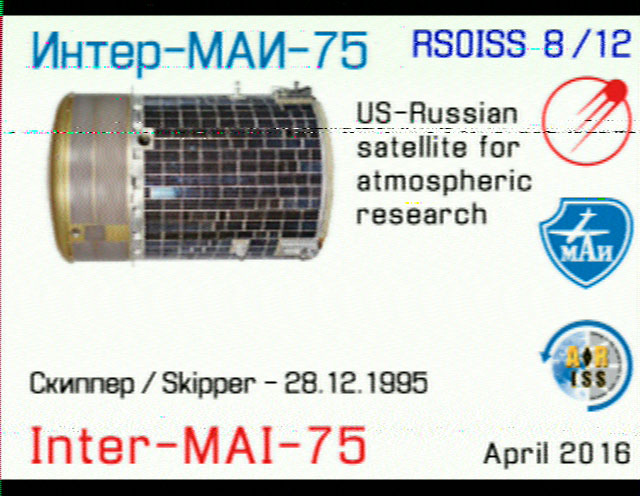
MAI-75 SSTV Image , 14 APRIL 2016

SSTV Image from ISS , 15:49 UTC 14 APRIL 2016

Image SSTV received 15:44 UTC, Just Got Quarter Image after AOS
MAI-75 April 14 and 15
Details are a bit sketchy at this point but it appears that the Moscow Aviation Institute will be conduction SSTV image transmissions from ISS on April 14 from around 15:00 to 18:00 UTC and again on April 15 from around 14:00 to 19:00. It appears they will be using the large image quality transmission mode of PD290 during this period. Folks will have to be extremely lucky to capture a full image during a pass of the ISS since the transmission time for each image will be nearly 5 minutes and there should be a gap between image transmissions to reduce the duty cycle on the radio. Transmissions are planned to occur on 145.800 MHz.
Source : http://ariss-sstv.blogspot.com
ARISS SSTV Image Over Indonesia , 16:38 UTC 2016-04-13
ARISS commemorative event (April 11-14)
SSTV Image received 16:38 UTC
SSTV Image received 16:43 UTC
Archive page for Image Gallery http://www.spaceflightsoftware.com/ARISS_SSTV/archive.php
SSTV mission blog http://ariss-sstv.blogspot.com/
First Recived SSTV Image from the "Expedition 47" mission.
A slow-scan television (SSTV) event commemorating the 15th anniversary of ARISS will take place this week. SSTV transmissions will begin on Monday, April 11 at approximately 1825 UTC. Allowing for breaks for scheduled school contacts, the transmissions will end on April 14 at 1135 UTC. Other “MAI-75” SSTV transmissions are expected to take place on April 14 and April 15, accessible in South America, Europe, Southeast Asia, and Australia.
not completted LOS Condition
Subscribe to:
Posts (Atom)Template Responsive Design